


A company's documents never stand still. Policies, plans, specifications and spreadsheets are added and revised every week, and an AI assistant is only as useful as its grasp of the latest ones. Retraining a model on every change is slow and costly, and updating its shared weights can overwrite what it learned before.
Our third research paper, Microfitting: Continual Learning via Cached Test-Time Training, presents a different approach. The base model stays frozen. Each document gets its own small fine-tune adapter, trained once offline on questions about that document, then cached and loaded whenever that document is queried. New documents add new adapters and revised documents get replacements, so nothing learned earlier is overwritten. Each adapter starts from the Internalizer, our document-to-adapter network, and reaches its best observed accuracy after a single pass of training.
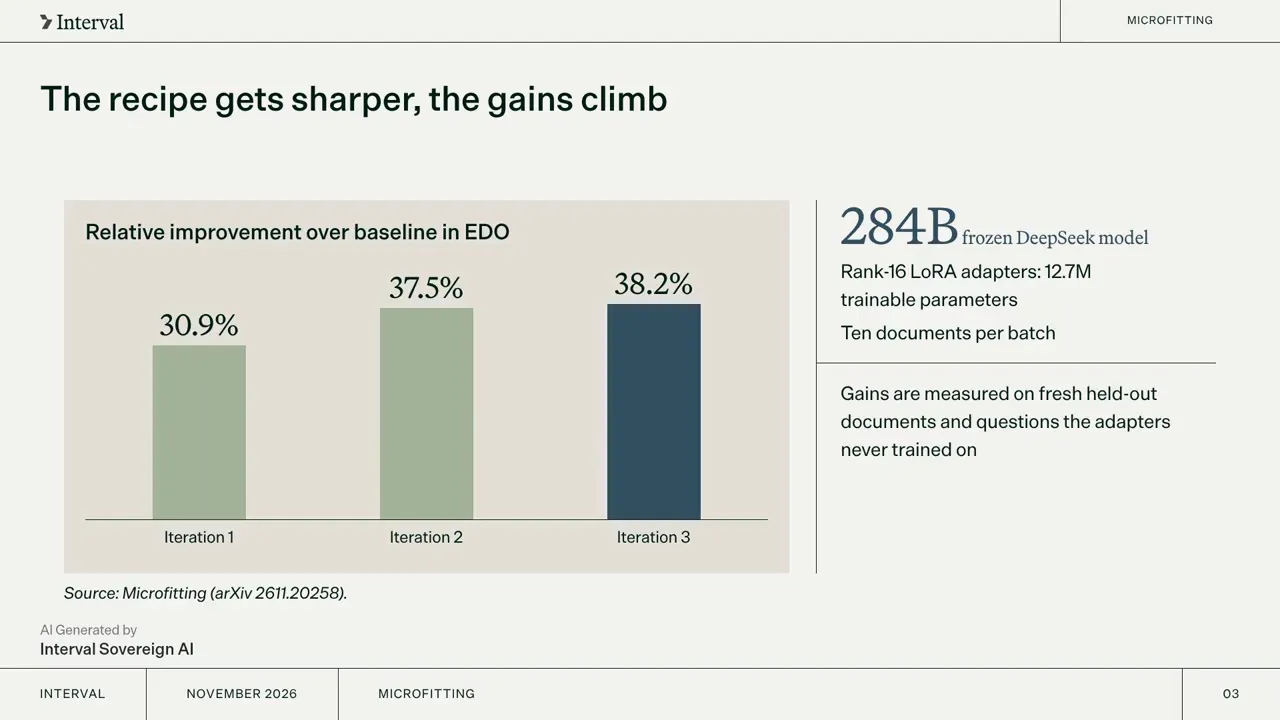
The system also improves how it teaches itself. After each batch, it measures which questions each adapter corrected or got wrong, compares its training questions with examples of the target workload, and proposes a revised recipe. A revision is adopted only if it does better on fresh documents and questions. On DeepSeek V4 Flash, a privately hosted open-weight model, relative improvement over the base model rose from 30.9% to 37.5% to 38.2% across three fresh batches of real-world enterprise documents.
Microfitting is built to run on customer-owned hardware, keeping documents, questions and the whole adaptation process private. On two workstation GPUs, a ten-document batch trains in 16.8 minutes, so a single machine can adapt several hundred documents overnight. The gains are largest on questions that compare, rank or count a few items within a document.
In this video, we walk through how microfitting works, what we measured and why continual learning matters for private AI. The work shows how organisations can keep a private model current with their own documents, on modest local hardware, without retraining the model itself.
Watch the video below to explore the research.